Showing posts with label books. Show all posts

Thursday, January 14, 2010

About Welts

I was critical of my last project because it was an all too familiar no-brainer. BWOF 09-06-137 presented the other end of the spectrum - a brand new technique I'd never done before - single welt pockets. I felt confident because I'd been successful with double welts using the technique from Pants for Real People, (Palmer & Alto, 2007). According to my convoluted mathematical logic, by definition, single welt pockets were twice as easy as double welt pockets. One-half the number of welts - multiply by the inverse - twice as easy! See? So I should have been able to knock out a single welt pocket in no time. Replacing BWOF's famously vague directions with clear and illustrated directions from Palmer and Alto would only make the task easier. However, I decided to practice a welt or two, just to be on the safe side.

The flaws in my logic became evident very quickly and my initial confidence was replaced with frustration. After two practice attempts, I kept getting the same bad results and I thought, "Forget the mathematical logic! Single welts are more of a PITA than double welts, not less." The end of the welt didn't slip into the opening to form a neat corner. I got more and more aggravated so I took a break. Eureka! The solution finally occurred to me in a flash. The end of the welt wouldn't slip into the opening because I sewed the opening closed. (Duh!) In the midst of my false confidence, I didn't pay close attention to the written directions and depended on the diagrams, which I misinterpreted. Rather than sew completely around the box, I was supposed to sew only one of the long parallel lines to attach the welt. Somehow the illustration gave me the impression I was supposed to sew all the way around the box. As a result of this epiphany, the ends of the welt slid easily into place and yielded the neat looking single welt I expected. When I reread the instructions more carefully, I realized my interpretation was completely wrong and the instructions never said sew the shorter ends of the box. That was an assumption on my part and like most assumptions, it was wrong.

Single welt pockets are no different than double welt pockets. Making one welt takes just as much patience and practice as making two. I spent an entire evening practicing these pockets and about the same amount of time putting them in the pants, but it was time well spent. I'm so glad I didn't get carried away by my confidence and attempt the pockets without first practicing the technique. That would have been a disaster.

Friday, December 4, 2009

Oh, No! It's Happening Again!

I've got a new addiction. Here's how I know I've been bitten by the quilting bug: I'm beginning to buy quilting books. I can't go into a store without looking at the selection of quilting books. Late last spring, I realized storage space in my sewing room was disappearing, so I sorted through my collection of sewing books and donated lots of them to the public library. I was very proud of myself. Now I'm buying more books. Of course, I knew this would happen. I just didn't think it would be quilting books.

As a beginning quilter, these are the books I've found most helpful.

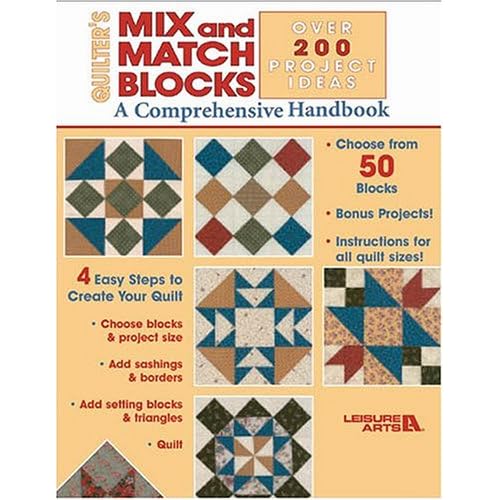
1. Quilter's Mix & Match Blocks: This book contains instructions for 50 blocks. Some blocks are very easy and some are more challenging. As a beginner, I appreciate the step-by-step block construction directions. I bought this book a few years ago, but never found the motivation to use it. Now, I'm really glad I bought it. It also includes directions for borders, batting and binding.

2. Start Quilting: This was the reference for the quilting class I took last spring. It covers all the basics, including directions for 6 easy blocks. As with the Mix and Match book, it has all the information you need to make a quilt from beginning to end.

3. Machine Quilting: As in garment sewing, there are certain quilting "celebrities" and Alex Anderson is one of them. I think the actual quilting (as opposed to piecing) is going to be the hardest thing for me to learn. I bought this book hoping Alex would make it easier. She didn't. It just takes practice, practice and practice.

4. The Quilting Answer Book: The subtitle of this book is "Solutions for Every Problem You'll Ever Face - Answers to Every Question You'll Ever Ask" and I really think that's true. Whenever I've had a question, I found it covered in this book. This book 6 1/2 x 4 1/2 and 1 inch thick - small enough to stick in my purse and carry around.

Book buying is not the only sign of my addiction. This week I drove TWICE to Steve's Sew and Vac in King of Prussia, PA – a notorious black hole shopping/traffic area, especially during the holiday season. And, after Steve's didn't have what I wanted, I drove 25 more miles to Hayes Sewing Machine Co. in Wilmington, DE. I had to get just the right fabric!

A few years ago, I got hooked on soap making. After the initial thrill wore off (and I had almost 100 bars of soap), I settled into making soap only when the mood hits me. I think the same thing will happen with quilting. So, I'm not worried that quilting will replace garment sewing as my major obsession. I will always, always be primarily a garment sewer. Quilting just gives me more of a variety of projects to sew.

Friday, April 24, 2009

No More Sewing Books

I shouldn't ever have to buy another sewing book. Ever. With my most recent purchase, everything I will ever need to know about sewing is already covered in somewhere my bookcase; most likely, in this book.

My newest sewing book is Professional Sewing Techniques for Designers (Cole and Czachor, 2009). (click the book to see ordering information from Amazon.com) I went to the bookstore at Philadelphia University to just look at the book. I didn't plan to actually buy it. Honest. The intended audience for this text is the design student who may not have a lot of sewing experience.The book tells students how to construct the garments after they've designed them – sort of a 500 page instruction sheet. The book goes from very basic information, such as how to layout pattern pieces on grain and sew a seam to more advanced techniques like how to make welt pockets and notched collars. The text is written from a designer's point of view, so the "why" of the techniques is addressed in addition to the "how". You learn why a lapped zipper might be a better design choice than a centered zipper in certain applications. This book is copiously illustrated! The features are shown in a variety of design sketches throughout the chapters. There are so many technical and fashion illustrations that the text isn't always on the same page as the illustration to which it refers and it's a little annoying to flip to page 132 to see an example of the gathered pocket described on page 122. While this book is written as a textbook for design students, home sewers can learn much by reading the highlighted "Important" notes and "Pattern Tips". The Pattern Tips provide drafting insights relevant to the topic. The Important Notes provide additional, sewing information to expand your skills. The end of each chapter has information on applying the techniques to difficult fabrics and criteria for critiquing your results.

This book, along with the books already in my sewing library, covers everything I always wanted to know about sewing and now, won't have to ask. I have the resources to design garments, draft the patterns for my designs, then sew them expertly. (hoo boy!) I don't need to buy another book until my skills match the level of books I already own. But, that doesn't mean I won't.

Friday, April 3, 2009

Pattern Drafting

Ever since Cidell enrolled in a pattern drafting class, I've been longing to do the same. There aren't a lot of pattern drafting classes around - even in a city as large as Philadelphia. The only pattern drafting classes I found were requirements for degree programs at local colleges and only for matriculating students. Philadelphia University, (formerly called Philadelphia College of Textiles and Sciences - with textiles in the name, I expected more) offered a certificate program in Industrial Sewing Methods with classes on Saturday mornings, and I enrolled several years ago. My daughter was younger then, and had soccer games and Girl Scout activities on Saturdays. After I missed most of a championship soccer game (which went into overtime and sudden death), I felt guilty and withdrew from the program. My daughter is all grown up now and I'm free to enroll again if I choose - without the guilt! In addition, the program has moved to Drexel University, which is closer to me. Back when I was enrolled, the program focused on fitting and construction, and not specifically on pattern making.

So, I am embarking on a journey to teach myself pattern making. I already own two books on patternmaking. Considering the cost of two well-known books; $99 for Patternmaking Made Easy (Amaden-Crawford, 2007) and $85 for Patternmaking for Fashion Design (Armstrong, 2005) , I can make the two books I already own work for me. Actually, the two books complement each other. Make Your Own Patterns (Bergh, 2006) is short on theory, but has clear step-by-step directions and excellent diagrams. How to Make Sewing Patterns (McCunn, 1977) has more theory, but it's line drawings are confusing. Both use the same approach - draft basic patterns according to your measurements and use the basic pattern as a template for making custom designs. The McCunn book has a section on taking your own measurements that will be particularly helpful for me, but I'll be depending more on Bergh for the actual patternmaking. I checked out How to Design Your Own Dress Patterns (Margolis, 1971) from the library. Margolis included exercises in manipulating quarter-scale pattern pieces. Manipulating the quarter-scale patterns helped me understand the theory and gain confidence. Neither Bergh nor McCunn included these exercises.

I've wanted to try patternmaking for over a year, but I finally feel ready to actually try making a pattern. I can work on patternmaking between garments. I enjoy having a long term project to work on at my leisure. And I do mean long term … I have no idea when (or if) I will finish this. My goal is to draft a simple, button-up short sleeve shirt. Yes, I know there are dozens of patterns for simple, button-up short sleeve shirts, but I want the challenge and the learning experience. I'll feel very proud if the result looks like a simple button-up short sleeve shirt when I'm finished.

Wednesday, February 25, 2009

Threads Industry Insider Techniques DVD

I asked Santa for this DVD. Apparently I was a naughty little girl because Santa did not bring it to me. So I bought it for myself. Before I sat down to watch it, I decided how I would judge it. If I learned something new, I'd be happy. If I learned something I could actually use, I'd be thrilled. Well, I'm thrilled!

Louise Cutting is the "Industry Insider" on the DVD. I'd seen her on TV (Sew Much More, I think) and I liked the techniques she demonstrated. I intended to buy her booklets, but never did. I suspect the techniques demonstrated on this DVD (and on the 2nd volume) are the same ones in her booklets. I'm a visual learner and I prefer having the DVD.

The techniques demonstrated are
  • Fuse and Interface a Hem
  • Hem Sheers With Ease
  • Mold the Smoothest Darts
  • Draft & Sew a Perfect Collar
  • Miter an Asymmetrical Corner
  • Create Bulk Free Facings
  • Serge Quick French Seams
I saw Cutting demonstrate the collar technique and the french seams before. Everything else was new to me. I'm sure I'll use the dart techniques and the mitered corners in future garments. Since this is a DVD, the techniques are arranged in chapters and you can skip to the chapter you want to see. The camera work is very good. The close-ups allow you to see exactly what is being done.

I'm going to buy Industry Insider Techniques, Vol 2 also. I'm not even going to waste my time asking Santa.

Monday, December 1, 2008

New Publications

While browsing in Borders and Barnes & Noble, I was fretting because it seemed there were no new sewing books or magazines on the market. Most of the books on the "needlearts" shelves were knitting and crocheting books - very few new sewing books. Luckily, thanks to online resources, I stumbled on some new sewing publications.

I'd heard about Stitch on Lori's Sew Forth Now podcast and looked for a copy. I found a copy at Borders and immediately picked it up. For an old sewer like me, Stitch is quite refreshing. The projects are modern and in most cases pattern pieces are included in the magazine. The cover promises "25 Contemporary Sewing Projects Inside" and the magazine delivers. It even includes full-size patterns (on a pull out sheet as in Burda World of Fashion) for three skirts. The sewing instructions for the skirts are included in a "How to" section along with instructions for fabric gift tags, a messenger bag and a Chakla Quilt. Something for everyone! I really like the messenger bag and will probably attempt it at some point. There were articles on green sewing and Natalie Chanin, author of Alabama Stitch Book, a sewer who uses handstitching and cotton jersey to create "eco-chic" clothing. The magazine should appeal new generation sewers - just what is needed to keep sewing alive.


A blurb in Stitch led me to The Dressmaker's Technique Bible by Lorna Knight (Krause Publications, 2008). It contains instructions on many basic techniques including waistbands, necklines, pockets and linings. There are also chapters on embellishment ideas - appliqué, couching, patchwork and piping. I call this book "Vogue Sewing Lite". The directions are not as detailed as those in Vogue Sewing and Vogue Sewing sometimes offers multiple options for the same task. For example, the welt pockets section in Vogue Sewing shows single welt, double welt and welt pocket with flap. In the Dressmaker's Bible, the only option is a double welt. The Dressmaker's Bible is illustrated with clear diagrams of the process and photographs of finished samples. The book is spiral bound so it's easy to have it open next to the machine. It won't replace Vogue Sewing as my "go to" resource, but it is good as a "refresher" for the various techniques included.

I purchased the Dressmaker's Bible from Amazon. Cool Couture by Kenneth King (Singer Studio, 2008) was suggested in the "customers also bought …" section. And, since I was in a book buying mood, I also bought it. King's book is as different from Knight's book as possible. King calls this book his "bag of tricks" and it is not your instructional book on basic construction techniques. The chapter on Pockets and Buttonholes includes, but is not limited to a Hidden Lining Pocket, Hidden Edge Pocket, and a Piped Welt Pocket. The samples in the photos are opulent and embellished just as you would expect from Kenneth King – true eye candy and lots of fun! My taste tends to be bland and boring conservative and classic. I'm honestly surprised that so many of the techniques appeal to me. I don't know if I will actually use any of them, but I love reading the book.

I'm happy to learn new sewing magazines and books are being published. I only have to keep my eyes and ears open to learn about them.

Sunday, October 5, 2008

There's No Business Like Show Business - Pt 2

It occurred to me that I never showed a picture of the dress I made for the Curio Theatre's production of "The Trial". This was really a fun project because it forced me to think outside the box - something I rarely do (and should do more often!). Aetna, the costume designer and one of the actresses, sketched her ideas and then found a pattern to use as a foundation. She chose Butterick 5049 for this design. She does some sewing herself and she knows her way around a pattern catalog. The challenge was adding the collar. I used Make Your Own Patterns by Rene Bergh for help on drafting the collar. I'm so glad I had this book. Drafting a pattern piece is much easier than I thought but I couldn't have done it without the clear instructions in the book. I plan to do more of it. Now that I've successfully completed this project, I have the confidence to make design changes to the garments I make for myself.

So, if you are in the area, come on down to Southwest Philadelphia and see the play. I'll be the one signing autographs!

Saturday, March 1, 2008

Ex Libris Elaray

Recently, I've added three books to my sewing library. These are not new publications. All were published in the mid 90s. (Isn't anybody writing sewing books anymore?) Although the information is not new, these books of full of techniques that really should be routine to me.

Beyond The Pattern is a compilation of articles from Threads Magazine when it was in it's glory days. The articles cover basic sewing techniques, like easing a sleeve cap and binding with bias, but they provide information that isn't included on pattern instruction sheets. Some of the articles are dated (like "Introducing the Rotary Cutter) but all contain useful information. Since I don't have an archive of Threads Magazine from the beginning, I'm trying to collect all of the titles from this series.


I like the Sewing Companion Library/Easy Guide series because they go into depth on the construction of a single category of garments. This series could be used as texts for sewing courses. If someone is just learning to sew, this book, and all the Sewing Companion Library, is great because it covers techniques that are usually not in most "learn to sew" level books. If I'd had these books when I was learning to sew, techniques like stabilizing seam allowances before installing zippers would be second nature to me and not something I need to be reminded to do.


Sewing Tips & Trade Secrets is full of techniques to improve sewing. The tips are conveniently arranged into chapters/categories, e.g. Patterns, Tools, Pressing etc. A chapter on hand-stitching is included and I want to improve my hand sewing so I'm paying particular attention to this chapter. The information is presented in tip format - often less than 5 sentences - so this book is great to take along as something quick to read while waiting.


None of these books contain new, earth-shattering information. I should be using many of the techniques anyway, but I have become to lazy rushed to do. Now that I'm trying to adopt the "slow sewing" mindset, these books remind me of techniques that improve the "value" of the clothing I make.

Monday, June 4, 2007

Sewing “Palate Cleanser”

About one year ago, I submitted pictures of my sewing room to Home Sewing Association’s web site. I was lucky enough to have my pictures selected for publication on the site and I received a box of sewing goodies for the honor. Included in the box was a copy of “Fabric Leftovers” by D’Arcy-Jean Milne. Since my primary focus is garment sewing, it isn’t the kind of book I would ever buy for myself. But, after completing several projects in succession, I needed a project to act as a “palate cleanser” - something easy to clear my mind before beginning the next garment project. So, I tried one of the projects contained in the book.

I chose a project using “Rug Canvas Fabric”. This fabric is made by weaving strips of leftover fabric into rug canvas and using a variety decorative stitches to secure the strips in the canvas. Rather than use leftover fabric, I used some of the coordinated fat quarters that were also included in my box of goodies. I really had no idea what it would be when I started, but it ended up being a fold-over wallet. I’m thinking of attaching some sort of cord or trim so that it can be used as a little over the shoulder purse for a pre-teen I know. It’s just big enough for a couple of dollars, a key and a cell phone.

The projects in this book are quick, easy and fun. I can make “Sweet Beads”, “Lazy Crazy Patchwork”, “Machine Wrap Cord” or “Button Blooms”. For an analytical control freak like me, these projects are a great way to allow my free, creative side to take over.

Sunday, May 20, 2007

Patterns from Finished Clothes

My entrepreneurial nephew, who recently opened his own barber shop, wants me to make him some barber smocks using fabric with LA Lakers and Oakland Raiders logos. Finding the Lakers and Raiders fabric wasn't a problem thanks to the resourceful sewers at PR. Finding a pattern for a size 4x barber smock? No Way! Fuhgeddaboudit! The only thing left to do is make a pattern from one of his smocks. To make this possible, I bought Patterns from Finished Clothes by Tracy Doyle. Several years ago, I took classes at Philadelphia University (formally Philadelphia College of Textiles and Sciences). I was enrolled in the Industrial Fashion Methods certificate program. One of the classes covered learning to copy clothing. I had to drop out in the middle of that course, so I never learned to copy a garment. In the class, we laid tracing paper over the garment to trace the pieces. Doyle uses another method -- putting paper under the garment and using a needle point tracing wheel to trace components of the garment. This method seems much easier than the method taught at Philadelphia University. After perusing the first 2 or 3 chapters, I actually believe I can make these smocks! The book is very heavily illustrated. The first half of the book gives detailed, step-by-step instructions for copying a yoked blouse. The rest of the book covers pleats, darts and other details. I wish those details were covered as thoroughly as the yoked blouse. However, I feel confident enough to attempt the smocks. I'll learn more by working through the process than by reading the book.

N. B. This is the same nephew who suckered me into trying to buy "Transformers" during the height of the craze back in the 80's. I certainly hope I'm more successful this time. It's a good thing I love him so much.

Monday, April 30, 2007

How to Make Sewing Patterns

Too often, I make things more difficult than they need to be. But, I usually learn something along the way, so it's not necessarily a bad thing. I discovered I could make a blouse using size 52 Burda Pattern and not do any adjustments or changes for fit (except to lengthen it, if I want). I have several Burda blouse patterns that only go up to size 50. In the past, I've pivoted and slid the bust to fit with no problem. Here's where I make things difficult -- I got the "Big Idea". Why not grade the whole pattern up to a 52 so it will fit as well as the 52's I'm now making? Because I don't know how to grade up, that's why! But I refused to let that stop me! I decided to get some information on making and grading patterns. I bought this book.

This book was originally published over 25 years ago and the artwork looks dated. The information is easy to understand, however. One of the most helpful sections has illustrations and instructions for measuring your own body. So far, I've only read the sections on drafting a straight skirt pattern. McCunn presents skirts first because they are the easiest to draft. Each step in the process is clearly illustrated and rationale explained. I appreciate knowing the reasons behind instructions rather than just being told what to do. I feel confident about drafting patterns with this book and my other pattern drafting book, Make Your Own Patterns by Rene Bergh. Both of these books are introductory and intended for the home sewer. My plan is to challenge myself and draft a pattern once school is out and I'm on vacation.

I guess I could continue to increase the bust by pivoting and sliding. It's an easy method and I've done it for years. But then, I wouldn't have learned half the things I know (about sewing and everything else) if I hadn't asked myself "Why not?" and gone off on these little "side trips".

Wednesday, April 25, 2007

Sewing with Knits

I've been buying quite a few new sewing books lately. Every once in a while I want to "kick it up a notch" and improve my skills. I don't have time to take classes so I buy books. "Sewing with Knits" by Connie Long is my latest acquisition. It is part of the Taunton Press Focus of Fabric series. I really liked "Linen and Cotton", the only other title in the series, so I decided to get this title, too.
Like the other title in this two book series, "Sewing with Knits' includes information on many techniques for many types of knits, i.e. swimsuit fabric, stretch velvet and stretch lace. Long includes techniques for both serger and conventional sewing machines. There is an entire chapter on working with swimsuit and specialty knits. Every technique is illustrated with photographs and drawings.
As I read this book, I realized it's been quite a while since I used knit fabrics. For some reason, I've overlooked knits when shopping for fabric. Now that I have "Sewing with Knits", I'm going to make an effort to use more knits.

Saturday, April 21, 2007

Linen and Cotton

Susan Khalje has become one of my favorite "nationally known sewing experts". I really like the techniques she demonstrates on "Sew Much More" on DIY Network. Because DIY Network changes its schedule without notice, "Sew Much More" can disappear at any time. There is only so much storage space on the DVR and I can't record and store every episode. So, I decided to purchase books Khalje has authored. I bought this copy from Alibris, my favorite online source for books, for less than $10, including shipping.

This book is exactly what I was looking for! It contains scores of techniques seldom found on instruction sheets. For example, in Chapter 5: Sewing techniques, I found the following techniques: false French seam, slot seam, braced seam, and self-bound seam. In Chapter 8, Finishing Details, I found instructions, with a drawing, for installing a grosgrain underlay to protect the skin from zipper teeth. I wasn't aware a technique such as that existed! Khalje's book has lots of the techniques she demonstrates on Sew Much More, like the hanging loops for skirts. The book has many diagrams and drawings to illustrate the techniques. The photographs show-off the details and augment the directions. This book is published by Taunton Press and the layout is similar to Threads Magazine 10 years ago.

The subtitle of this book says it all: "Classic Sewing Techniques for Great Results". I'm going to make a point of learning and using the techniques in Linen and Cotton.

This book appears to be part of a series called "Focus on Fabric." I've found only one other title in the series; Sewing with Knits by Connie Long. For some reason, I haven't been able to find this title for less than $30 and the copies are used. If Long's book is anything like Khalje's, I may just buy it anyway!

Tuesday, April 17, 2007

Fit for Real People

As my old Granny used to say, "Everything ain't for everybody." Actually, my grandmother never said that, but it's still true. Lots of people on Pattern Review love "Fit for Real People". "My Fit Bible" said one reader. "...by far my favorite", said another. "If I were to own only one book on fit, this would be the one", a third reader proclaimed. It's one of Pattern Review's top 15 books, for goodness' sake. Me? I was less than impressed. Admittedly, I haven't tried Palmer and Alto's methods yet, but I don't think I'll like it. It's tissue fitting! Ugh!

I will not try it in a boat.
I will not try it in a coat.
I will not try it with a fox.
I will not try it in my socks.
I will not tissue fit -- No, Ma'am!
I will not do it, Sam I Am!


First of all, you need a partner. Getting someone to help you tissue fit is like getting someone to help you move. You can only ask your closest, dearest friends and you totally understand if they say, "no!". Secondly, I tried tissue fitting once. (Once!) I sweated and ruined the pattern!!! What a mess!

The book is very easy to read and I do plan to read it throughly. Maybe after I read it, I'll be willing to try tissue fitting again. Maybe I'll be like the character in Dr. Seuss' book and discover I like Green Eggs and Ham after all!

Wednesday, April 11, 2007

Learning to Draft patterns.

I bought Make Your Own Patterns by Rene Bergh. I used my 40% off coupon from JoAnn, so the cost was only $10.77. After a preliminary reading, I think I could make a pattern for a simple pullover blouse and skirt. The book gives step by step detailed directions on drafting each line in a bodice front and back, sleeve, pants and skirt. Then, it gives directions for drafting style details like gathers at the neck, shawl collar, kimono sleeves and pleated pants. There is even a chapter on drafting a pattern for jeans. Quarter scale pattern pieces are included with directions on how to grade up the pieces. If I never draft a pattern piece, the information on grading up will be worth at least the $10.77 I spent.

This is the first book on pattern drafting I've read, so I have nothing to compare. This 127 page book isn't intended to be a definitive text on pattern drafting. I still would like a little more information on grading-up. It is a good introduction, though. Now that I've seen this introduction, I can look for the additional resources I need. After I work through a few pieces in this book, I can move up to a more "intense" text.